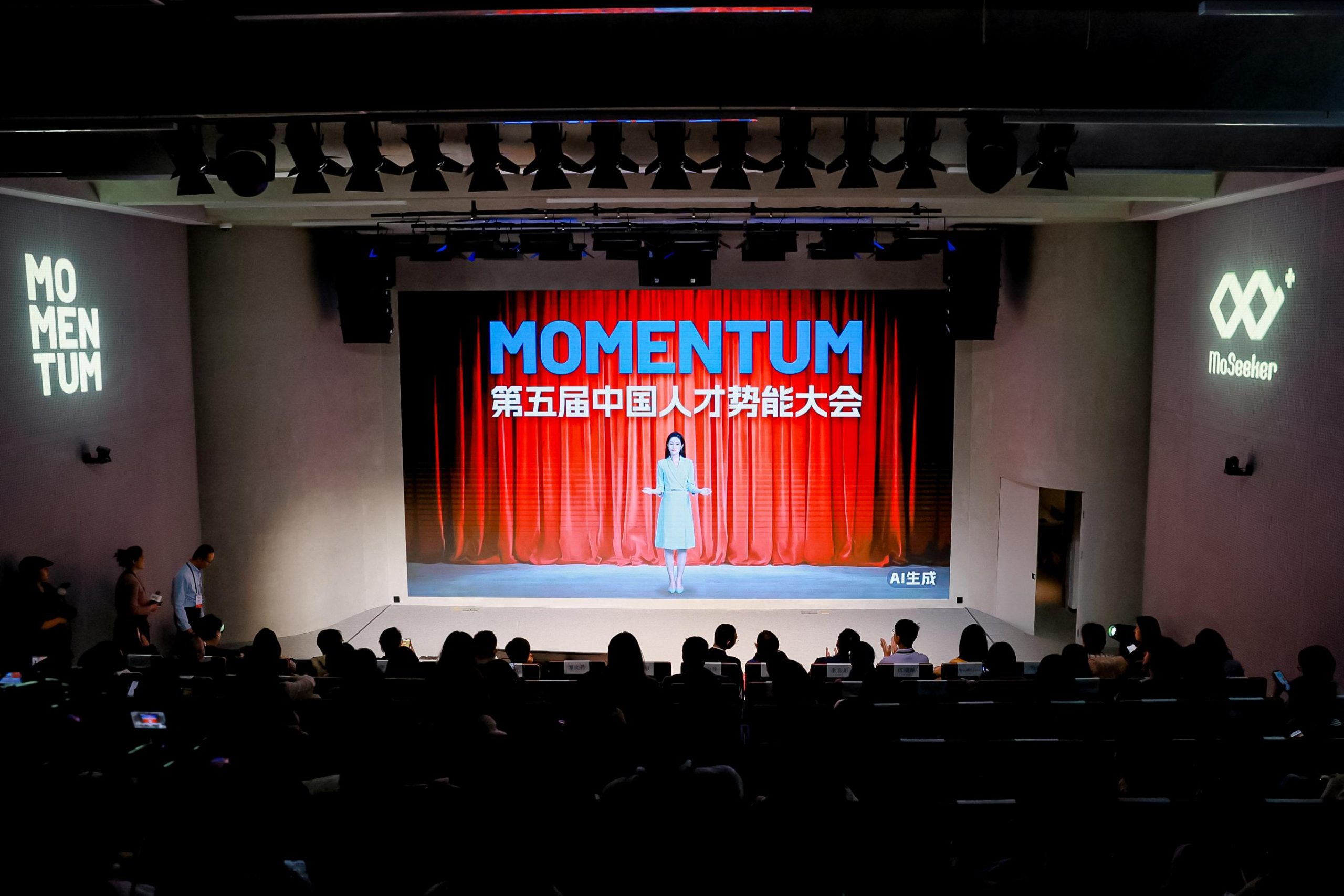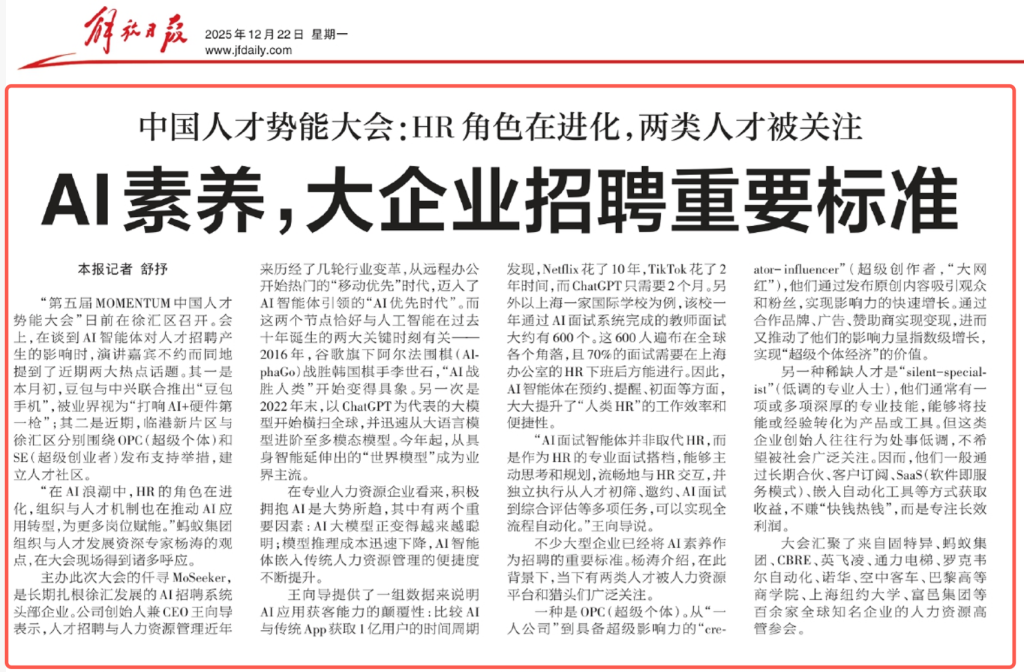
The 5th MOMENTUM Conference was recently held in Xuhui District. During the event, when discussing the impact of AI agents on talent recruitment, speakers unanimously highlighted two current hot topics. The first is the launch of the “Doubao Phone” jointly by Doubao and ZTE earlier this month, which the industry sees as the first decisive move in the integration of AI and hardware. The second is the recent introduction of support measures around OPC (Outstanding Personal Capability) in the Lingang New Area and SE (Super Entrepreneur) in Xuhui District, both aimed at establishing talent communities.
“In the wave of AI, the role of HR is evolving, and organizational alongside talent mechanisms are driving the transformation of AI applications, empowering more job positions,” said Yang Tao, Senior Talent & Organizational Development Expert at Ant Group, whose viewpoint resonated widely at the conference.
The conference was organized by MoSeeker, a leading AI-driven recruitment platform company rooted in Xuhui. Wang Xiangdao, the founder and CEO, noted that talent recruitment and HR management have undergone several rounds of industry transformation in recent years. The sector has shifted from the ‘mobile-first’ era popularized by remote work, into the ‘AI-first era’ dominated by AI agents. These two milestones coincide with pivotal moments in AI history over the past decade: in 2016, Google’s AlphaGo defeated Korean Go player Lee Sedol, making “AI defeating humans” a concrete reality; and at the end of 2022, large models led by ChatGPT swept the globe, quickly advancing from large language models to multi-modal models. Starting this year, “world models” derived from embodied intelligence have become mainstream in the industry.
From the perspective of professional HR companies, actively embracing AI is a clear trend driven by two key factors: large AI models are becoming increasingly intelligent, and the cost of model inference is rapidly decreasing, making the integration of AI agents into traditional HR management ever more convenient.
To illustrate the revolutionary user acquisition capabilities of AI, Wang Xiangdao shared some data: comparing the time it takes for AI and traditional apps to reach 100 million users, Netflix took 10 years, TikTok 2 years, while ChatGPT only needed 2 months. For instance, take an international school in Shanghai—its AI interview system handles about 600 teacher interviews a year. These 600 candidates are scattered across the world, and 70% of their interviews need to be conducted outside business hours for the school’s HR team in Shanghai. Thus, in scheduling, reminders, and preliminary interviews, AI agents have greatly improved the efficiency and convenience of human HR professionals.
“AI interview agents are not meant to replace HR professionals, but rather to serve as their specialized interview partners,” said Wang Xiangdao. “They can proactively think and plan, communicate seamlessly with HR, and independently carry out multiple tasks—from initial talent screening and invitations to AI interviews and comprehensive evaluations—enabling full-process automation.”
Many large enterprises have already made AI literacy an important criterion in their recruitment process. Yang Tao explained that, against this backdrop, two types of talent are currently being closely watched by HR platforms and headhunters.
The first is OPC (Outstanding Personal Capability), or “super individuals.” Ranging from “one-person companies” to highly influential creator-influencers, they attract audiences and followers by producing original content, rapidly expanding their impact. By collaborating with brands, advertising sponsors, and monetizing their platforms, they are able to exponentially grow their influence and realize the value of the “super individual economy.”
The other sought-after talent is the “silent specialist”—low-profile professionals with one or more advanced skills who are able to translate their expertise and experience into products or tools. These founders tend to keep a low profile, preferring to avoid widespread public attention. As a result, they typically earn income through long-term partnerships, client subscriptions, SaaS (software-as-a-service models), and embedding automation tools. Rather than chasing quick profits, they are focused on sustainable, long-term growth.
The conference brought together HR executives from more than one hundred world-renowned organizations, including Goodyear, Ant Group, CBRE, Infineon Technologies, KONE, Rockwell Automation, Novartis, Airbus, HEC Paris, NYU Shanghai, and Treasury Wine Estates, among others.
By Shu Shu
Original Report